Before diving into the logistics, it’s crucial to honestly assess whether this business aligns with your interests and BC’s unique market conditions. Here are the key indicators that suggest lawn mowing could be your ideal venture in British Columbia:
🌲 You’re Passionate About BC’s Outdoor Lifestyle
The biggest advantage of a lawn care business in BC is spending your days enjoying the province’s beautiful climate and stunning mountain backdrop 🏔️. BC’s mild coastal climate means longer growing seasons compared to other Canadian provinces – from March through November in the Lower Mainland! However, this means working in BC’s famous rain 🌧️ as well as sunny days. If you genuinely enjoy being outside in BC’s variable weather, this could be perfect for you.
💪 You Don’t Mind Physical Demands in BC’s Terrain
Lawn care in BC often involves unique challenges like sloped properties (especially in West Vancouver, Burnaby Heights, and North Shore areas), coastal moisture conditions, and varied grass types. You’ll be navigating BC’s hilly terrain while maintaining equipment in higher humidity 💦. If you enjoy physical activity and don’t mind the workout, this business offers great exercise along with income while enjoying BC’s natural beauty.
🧠 You Understand BC’s Unique Lawn Care Needs
BC’s climate creates specific lawn care challenges: moss growth due to coastal moisture, different grass varieties than prairie provinces, and year-round growing conditions in some areas. Clients expect expertise in dealing with BC-specific issues like moss control, Pacific Northwest plant diseases, and rain-tolerant grass varieties 🌿. Consider practicing on friends’ and family members’ lawns to understand local conditions.
📅 You’re Ready for BC’s Extended but Variable Season
Unlike other provinces, BC lawn care businesses can operate 8-10 months per year, especially in coastal areas 🌊. Peak demand runs from April through October, with some winter work available (pruning, cleanup). Successful BC business owners plan for the rainy season by offering complementary services or focusing on equipment maintenance and customer relationship building during November-February.
🗣️ You’re Comfortable with BC’s Diverse Customer Base
Running a lawn care business in BC means serving diverse communities – from affluent West Vancouver neighborhoods to growing Surrey suburbs, from Richmond’s newer developments to Victoria’s heritage properties 🏡. Strong communication skills and cultural sensitivity are just as important as your mowing expertise in BC’s multicultural communities.
🚜 Understanding Different Types of Lawn Mowers
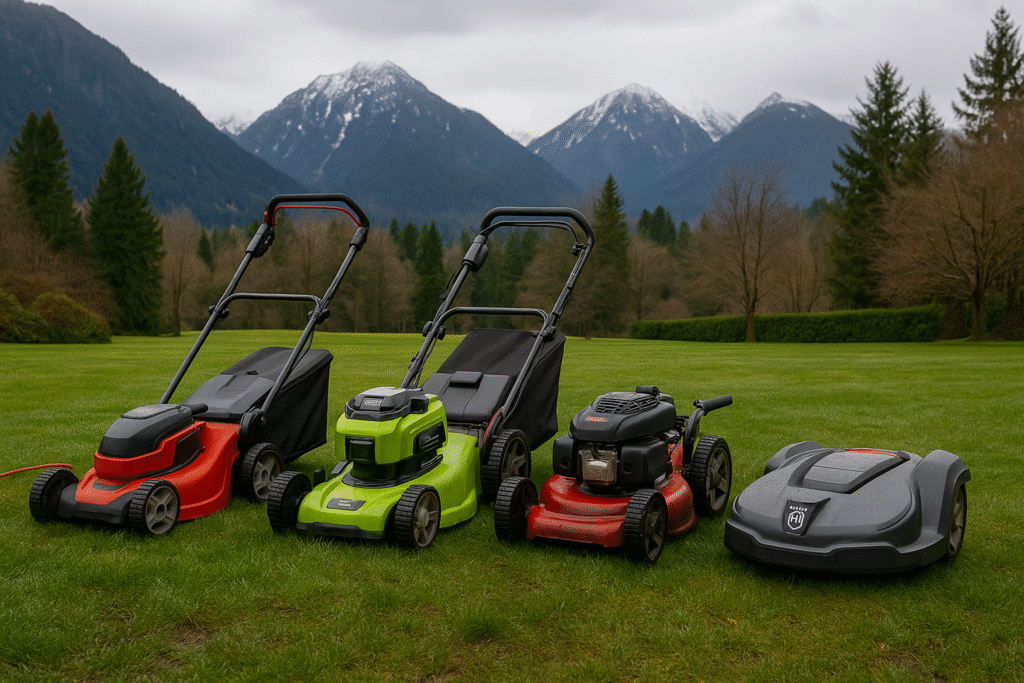
Your choice of mower will significantly impact your efficiency, operating costs, and the types of jobs you can handle. Let’s explore the main categories:
⚡ Corded Electric Mowers
⚡ Corded Electric Mowers are lightweight, eco-friendly lawn mowers powered by an extension cord plugged into a standard electrical outlet. They offer consistent power without the need for gas or batteries, making them ideal for small to medium-sized yards with easy access to outlets. However, their range is limited by cord length, and users must manage the cord while mowing. Perfect for those seeking a low-maintenance, quiet, and budget-friendly mowing option.
Best for: Small lawns (under 1/4 acre), budget-conscious startups, quiet residential areas 🏘️
Advantages:
Lightweight and easy to maneuver 🪶
No fuel costs or emissions 🌱
Minimal maintenance required 🔧
Quieter operation than gas mowers 🔇
Lower upfront investment 💸
Disadvantages:
Limited by cord length (typically requiring extension cords) 🔌
Risk of running over the cord ⚠️
Less powerful than gas alternatives
Not suitable for larger properties
Typical Cost: $200-$500 💵
🔋 Cordless (Battery-Powered) Mowers
🔋 Cordless (Battery-Powered) Mowers run on rechargeable lithium-ion batteries, offering the freedom of movement without a cord or gas. They’re quieter, cleaner, and easier to start than gas mowers, making them ideal for suburban homeowners. Most models can handle small to medium-sized lawns on a single charge, though runtime and cutting power depend on battery size and mower type. Great for those who want convenience, lower emissions, and less maintenance.
Best for: Small to medium lawns, eco-conscious customers 🌍, early morning or late evening work 🌅
Advantages:
Freedom of movement without cords 🆓
Environmentally friendly operation 🌿
Quiet enough for early morning use 🤫
Lower operating costs than gas mowers
Many brands offer interchangeable batteries across tool lines 🔄
Disadvantages:
Limited by battery life (typically 30-60 minutes) ⏰
Higher upfront costs for quality batteries 💰
Battery replacement costs over time
May lose power as battery drains 📉
Typical Cost: $300-$800 for consumer models, $800-$2,000 for commercial-grade
Key Considerations:
How long does the battery last? ⏱️ Most quality batteries provide 45-60 minutes of runtime
Can you use the same battery for other tools? 🛠️ Many manufacturers offer tool ecosystems
What happens if the battery dies mid-job? 🔋 Always carry backup batteries
⛽ Gas-Powered Mowers
⛽ Gas-Powered Mowers are the traditional choice for power and performance, ideal for large or tough lawns with thick grass or uneven terrain. They run on gasoline, offering strong cutting ability and long runtime without cords or batteries. However, they require regular maintenance (like oil changes and spark plug replacements), are noisier, and emit exhaust fumes. Best suited for users who prioritize power and don’t mind the upkeep.
Best for: Large properties, thick grass 🌾, commercial operations, maximum power needs 💨
Advantages:
Most powerful option for thick, tall grass 💪
Unlimited runtime with fuel refills ⛽
Faster cutting speeds for efficiency 🏃♂️
Wide variety of sizes and configurations
Generally lower upfront costs for commercial-grade equipment
Disadvantages:
Higher operating costs (fuel, oil, maintenance) 💸
Emissions and environmental impact 🏭
Noise restrictions in some areas 📢
Regular maintenance requirements 🔧
Heavier and more difficult to transport 🚛
Typical Cost: $400-$1,200 for walk-behind models, $3,000-$15,000+ for commercial riding mowers
Maintenance Requirements:
Oil changes every 25-50 hours of operation 🛢️
Air filter cleaning/replacement 🌪️
Spark plug replacement annually ⚡
Regular blade sharpening 🔪
🤖 Robot Mowers
🤖 Robot Mowers are autonomous, battery-powered machines that mow your lawn on their own using sensors and boundary wires or GPS. They’re ultra-convenient, operating quietly and regularly to keep grass evenly trimmed with minimal human effort. While they’re ideal for maintaining small to medium lawns, they come with a higher upfront cost and need proper setup. Perfect for tech-savvy homeowners who want a “set it and forget it” lawn care solution.
Best for: Affluent clients wanting automated maintenance, tech-savvy business owners, premium service offerings 💎
While not typically used by lawn care businesses directly, understanding robot mowers is important because:
They represent a premium market segment 💰
Clients may ask about installation and maintenance services 🔧
They can complement traditional services for high-end customers 🏆
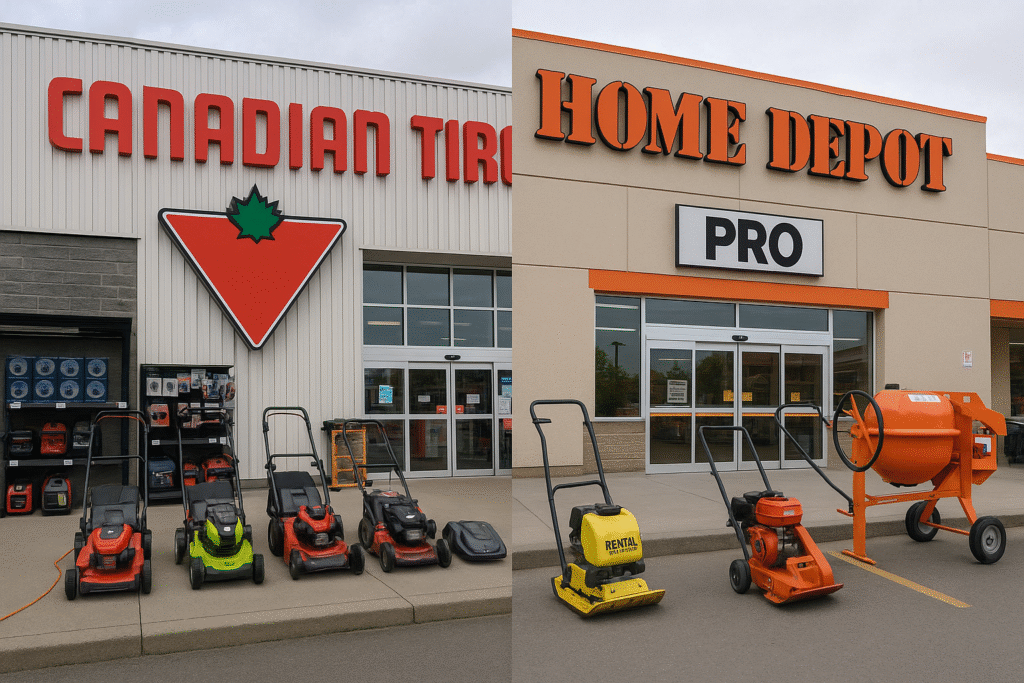
🏪 BC Retailer Equipment Sourcing: Canadian Tire vs Home Depot
Understanding equipment availability at BC’s major retailers helps you source efficiently and ensures warranty support across the province.
🇨🇦 Canadian Tire BC Brands, Locations & Advantages
🔋 Cordless (Battery-Powered) Mower Brands
Yardworks – 48 V brushless models for medium-sized lawns
Mastercraft – 20 V PWR POD line, including 14‑ and 18‑in push mowers
EGO – Premium 56 V self‑propelled and push models
WORX – PowerShare system in 17‑in and 40 V combo kits
Greenworks – Part of the wide cordless mower selection
RYOBI – Also included in the major cordless offering
🔌 Corded Electric Mower Brands
Greenworks and Mastercraft are featured prominently in the electric lineup
⛽ Gas-Powered Mower Brands
Yardworks – Includes Yardworks-branded QPT™ gas mowers
Troy‑Bilt – Common gas-powered option
Cub Cadet – Offers a range from walk‑behind to riding and zero‑turn units
Certified – Canadian Tire’s private‑label gas mowers with engines from RATO or Briggs & Stratton
Major BC Locations: 📍
Metro Vancouver: 15+ locations including Vancouver (Cambie, Grandview), Burnaby (Brentwood, Lougheed), Surrey (Guildford, Newton), Richmond, Coquitlam
Vancouver Island: Victoria (Tillicum, Uptown), Nanaimo, Courtenay, Campbell River
Interior: Kamloops, Kelowna, Vernon, Penticton, Prince George
BC-Specific Advantages: ✨
Triangle Rewards Program: Earn Canadian Tire Money on purchases 💰
Local inventory: Better stock of equipment suited for BC’s coastal climate 🌊
Service centers: Most BC locations offer equipment repair services 🔧
Seasonal sales: Major spring equipment sales (March-May) perfect for BC’s extended season 📅
🏠 Home Depot BC Locations & Focus
🔋 Cordless (Battery-Powered) Mowers
RYOBI – Includes 18 V, 40 V HP, and 80 V battery systems
DEWALT – 20 V MAX brushless models
Milwaukee – M18 FUEL cordless push mowers
Makita – 18 V/36 V LXT platform
ECHO – 56 V battery-powered units
BLACK+DECKER – 40 V MAX lineup
🔌 Corded Electric Mowers
RYOBI and BLACK+DECKER are most common, along with basic in-house corded models
⛽ Gas-Powered Mowers
Toro – Push and self-propelled models with Briggs & Stratton engines
Honda – Known for high-quality, reliable gas mowers
Cub Cadet, Troy‑Bilt, Columbia, Ariens, John Deere – Offer riding, zero-turn, and walk-behind mowers
Major BC Locations: 📍
Metro Vancouver: 20+ locations including Vancouver (Cambie, Terminal), Burnaby (Lougheed), Surrey (Newton, Cloverdale), Richmond, Coquitlam, North Vancouver
Fraser Valley: Langley, Abbotsford, Chilliwack
Vancouver Island: Victoria (Tillicum), Nanaimo, Courtenay
Interior: Kamloops, Kelowna, Prince George
BC-Specific Advantages: ✨
Professional contractor focus: Better for scaling operations 👷♂️
Pro services: Dedicated contractor support and bulk pricing 💼
Special orders: Can source specialized equipment not in stock 📦
Online integration: Strong e-commerce with store pickup options 💻
📊 BC Equipment Sourcing Strategy
Equipment Type
Best BC Source
Why
Price Range (BC)
Entry-level electric mowers ⚡
Canadian Tire
Better warranty support, local service
$250-$600
Professional gas mowers ⛽
Home Depot
Contractor focus, better commercial options
$600-$2,000
Battery systems (RYOBI) 🔋
Home Depot
Exclusive RYOBI ecosystem
$400-$1,200
EGO equipment 🌟
Both stores
Compare pricing, Canadian Tire often better sales
$500-$1,500
Replacement parts 🔧
Canadian Tire
Better local inventory for repairs
$15-$200
Safety equipment 🦺
Both stores
Similar pricing, choose based on convenience
$100-$300
🎯 BC Seasonal Buying Strategy
Best Times to Buy in BC: 📅
Late February/Early March: Pre-season sales before BC’s early spring
Canada Day Weekend: Major summer sales at Canadian Tire
September: End-of-season clearance (great for next year’s inventory)
Boxing Day: Significant discounts on equipment for winter storage
All-weather capability: Choose equipment that handles BC’s rain and humidity
Electric preference: Many BC customers prefer eco-friendly electric options
Moss control equipment: Consider specialized tools for BC’s moss problems
📊 Brand Comparison Table
Brand
Available At
Power Type
Price Range
Best For
Warranty
Key Features
Yardworks 🇨🇦
Canadian Tire Only
Gas/Electric/Battery
$200-$800
Budget-conscious homeowners
3 years
QPT technology, Canadian support
EGO POWER+ ⚡
Both stores
Battery (56V)
$600-$1,200
Performance-focused users
5 years tool/3 years battery
Industry-leading battery tech
RYOBI 🔋
Primarily Home Depot
Battery (40V)
$299-$899
DIY enthusiasts
3 years tool/3 years battery
ONE+ ecosystem compatibility
Toro 🏆
Both stores
Gas/Electric
$400-$1,500
Quality-focused homeowners
2-5 years
Personal Pace®, superior cut quality
DEWALT 💪
Home Depot
Battery (20V/60V)
$500-$1,200
Professional contractors
3 years
FlexVolt technology
Greenworks 🌱
Both stores
Electric/Battery
$200-$700
Eco-conscious users
4 years
Environmentally friendly
BLACK+DECKER 💰
Home Depot
Electric/Battery
$150-$400
Budget buyers
2 years
Simple, affordable options
Mastercraft 🛠️
Canadian Tire Only
Gas/Electric
$300-$600
Canadian homeowners
3 years
Good value, local support
🔍 Detailed Mower Type Comparison
🔌 Electric Mower Types Comparison
Feature
Corded Electric
Battery-Powered
Hybrid Electric
Runtime ⏰
Unlimited (with cord)
30-80 minutes
Varies by battery
Power Consistency ⚡
Constant full power
May decrease as battery drains
Constant with cord/backup battery
Mobility 🚶♂️
Limited by cord length
Complete freedom
Best of both worlds
Maintenance 🔧
Minimal
Battery replacement needed
Moderate
Initial Cost 💵
$200-$500
$300-$1,200
$400-$800
Operating Cost 💰
Electricity only
Battery replacement
Electricity + batteries
Best For 🎯
Small yards near outlets
Medium yards, convenience
Versatile use cases
Noise Level 🔇
Low
Very low
Low
Environmental Impact 🌍
Low (clean electricity)
Low-medium (battery disposal)
Low
⛽ Gas vs Electric Performance Comparison
Aspect
Gas Mowers
Electric Mowers
Winner
Raw Power 💪
Higher torque, cuts through anything
Good for most conditions
Gas ⛽
Runtime ⏱️
Unlimited with fuel
30-80 minutes per charge
Gas ⛽
Starting 🚀
Pull cord (may be difficult)
Push button start
Electric ⚡
Maintenance 🔧
Oil changes, tune-ups, winterizing
Minimal maintenance
Electric ⚡
Noise Level 🔊
High (85-95 dB)
Low (60-75 dB)
Electric ⚡
Emissions 🌍
Produces emissions
Zero direct emissions
Electric ⚡
Weight ⚖️
Heavier (60-100 lbs)
Lighter (40-70 lbs)
Electric ⚡
Operating Cost 💸
Fuel, oil, maintenance
Electricity/battery replacement
Electric ⚡
Weather Dependency 🌦️
Cold weather starting issues
Works in all temperatures
Electric ⚡
Initial Cost 💰
Generally lower
Higher upfront cost
Gas ⛽
🚜 Mower Size and Cutting Width Comparison
Cutting Width
Yard Size
Time to Mow 1/4 Acre
Best Mower Type
Typical Price Range
13-16 inches 📏
Under 2,000 sq ft
45-60 minutes
Corded electric
$150-$400
17-19 inches 📏
2,000-5,000 sq ft
35-45 minutes
Battery/small gas
$250-$600
20-21 inches 📏
5,000-10,000 sq ft
25-35 minutes
Gas/premium battery
$350-$800
22-24 inches 📏
10,000-15,000 sq ft
20-30 minutes
Self-propelled gas
$500-$1,200
30+ inches 📏
15,000+ sq ft
15-25 minutes
Riding mower/tractor
$1,500-$5,000+
🔋 Battery Technology Comparison
Brand
Voltage
Battery Life
Charge Time
Interchangeable
Best Features
EGO 56V ⚡
56V
45-80 minutes
40-60 minutes
Yes (EGO tools)
Fast charge, weather resistant
RYOBI 40V 🔋
40V
35-75 minutes
90-120 minutes
Yes (300+ tools)
Largest ecosystem, affordable
DEWALT 60V 💪
60V/20V
60-90 minutes
60-90 minutes
Yes (FlexVolt system)
Professional grade, dual voltage
Greenworks 40V 🌱
40V
40-60 minutes
60-90 minutes
Yes (Greenworks tools)
Eco-friendly, good value
Milwaukee 18V 🔴
18V
30-50 minutes
60-90 minutes
Yes (M18 system)
Professional quality, compact
🏆 Brand Recommendations by Business Type
🏠 Residential Lawn Care Startup
Best Choices:
Primary: RYOBI 40V system for versatility and ecosystem 🔋
Secondary: Yardworks for Canadian support and value 🇨🇦
Premium: EGO for superior performance and battery life ⚡
👔 Professional Service Business
Best Choices:
Primary: Toro for reliability and cut quality 🏆
Secondary: DEWALT for professional contractor credibility 💪
Budget: Mastercraft for cost-effective Canadian option 🛠️
🌱 Eco-Focused Business
Best Choices:
Primary: Greenworks for environmental credentials 🌍
Secondary: EGO for clean, powerful performance ⚡
Budget: BLACK+DECKER electric for affordable green option 💰
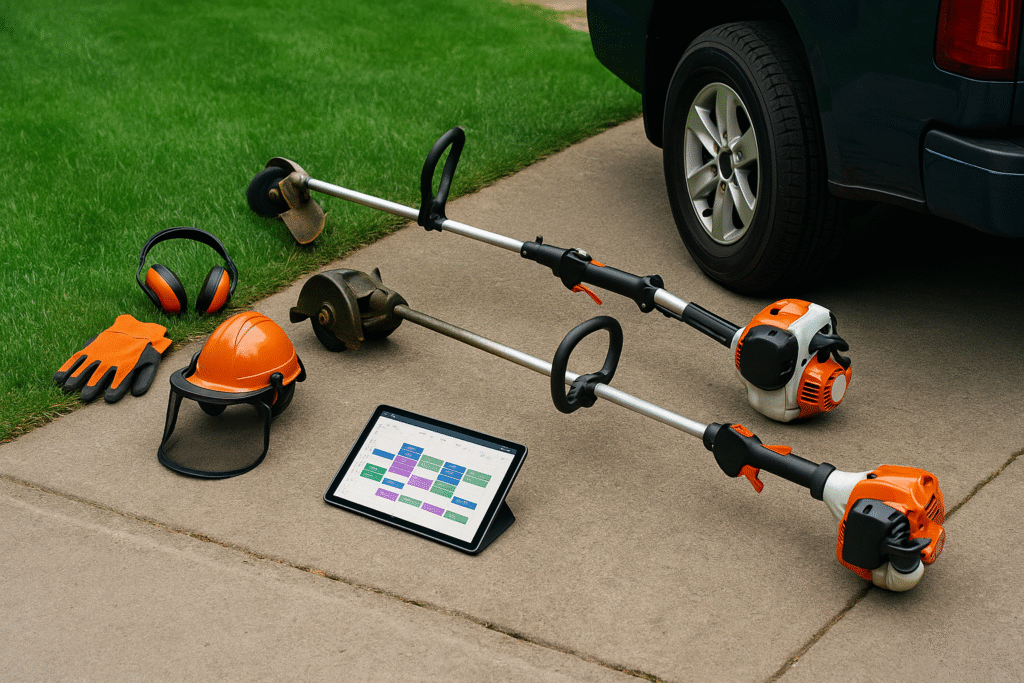
🛠️ Essential Equipment Beyond the Mower
A successful lawn mowing business requires more than just a mower. Here’s your complete equipment checklist:
✂️ Cutting and Trimming Tools
String Trimmer/Weed Eater: For edges and tight spaces ($150-$400) 🌿
Edger: For clean lines along sidewalks and driveways ($200-$500) ➖
Hedge Trimmer: For basic shrub maintenance ($100-$300) 🌳
Hand Tools: Rakes, shovels, pruning shears ($100-$200) 🛠️
🦺 Safety Equipment
Eye Protection: Safety glasses or goggles 👓
Ear Protection: Noise-reducing headphones or earplugs 🎧
Work Gloves: Durable, comfortable hand protection 🧤
Safety Boots: Steel-toed boots with good traction 👢
High-Visibility Clothing: Especially important when working near roads 🚧
🚚 Transportation and Storage
Vehicle: Truck or van capable of hauling equipment 🚐
Trailer: For larger equipment and multiple jobs per day ($1,000-$5,000) 🚛
Ramps: For loading heavy equipment ⬆️
Tie-downs and Straps: To secure equipment during transport 🔗
Storage Solution: Secure location for overnight equipment storage 🏠
📱 Business Equipment
Smartphone/Tablet: For scheduling, GPS, and customer communication 📞
Credit Card Reader: For easy payment processing 💳
Business Cards: Professional marketing materials 🎯
Measuring Tools: For accurate property assessments 📏
Total Equipment Investment: $3,000-$30,000 depending on scale and quality choices 💰
⚖️ Legal Requirements and Business Setup
Establishing your business legally protects you and builds customer confidence 🛡️. Here’s what you need to know:
📋 Business Registration
Business License: Required in most areas ($50-$200 annually) 📜
EIN (Employer Identification Number): Necessary if hiring employees or forming an LLC 🔢
Business Structure: Choose between sole proprietorship, LLC, or corporation 🏢
Local Permits: Check city and county requirements for lawn care businesses 🏛️
🛡️ Insurance Requirements
General Liability Insurance: Protects against property damage and injury claims ($33-$58 monthly for lawn care) 💼
Additional Coverage to Consider:
Commercial Auto Insurance: If using vehicles for business 🚗
Equipment Insurance: Protects against theft and damage 🔒
Workers’ Compensation: Required when hiring employees 👷♂️
📄 Specialized Licenses
Pesticide License: Required in every state for applying any EPA-registered products 🧪. Even if you start with just mowing, you may want this for future service expansion.
📋 Service Agreements
Develop clear contracts that outline:
Services provided ✅
Pricing and payment terms 💰
Cancellation policies ❌
Liability limitations ⚖️
Property access requirements 🔑
💰 BC-Specific Pricing Strategy
Proper pricing is crucial for profitability in BC’s competitive market. Here are pricing models and considerations for British Columbia:
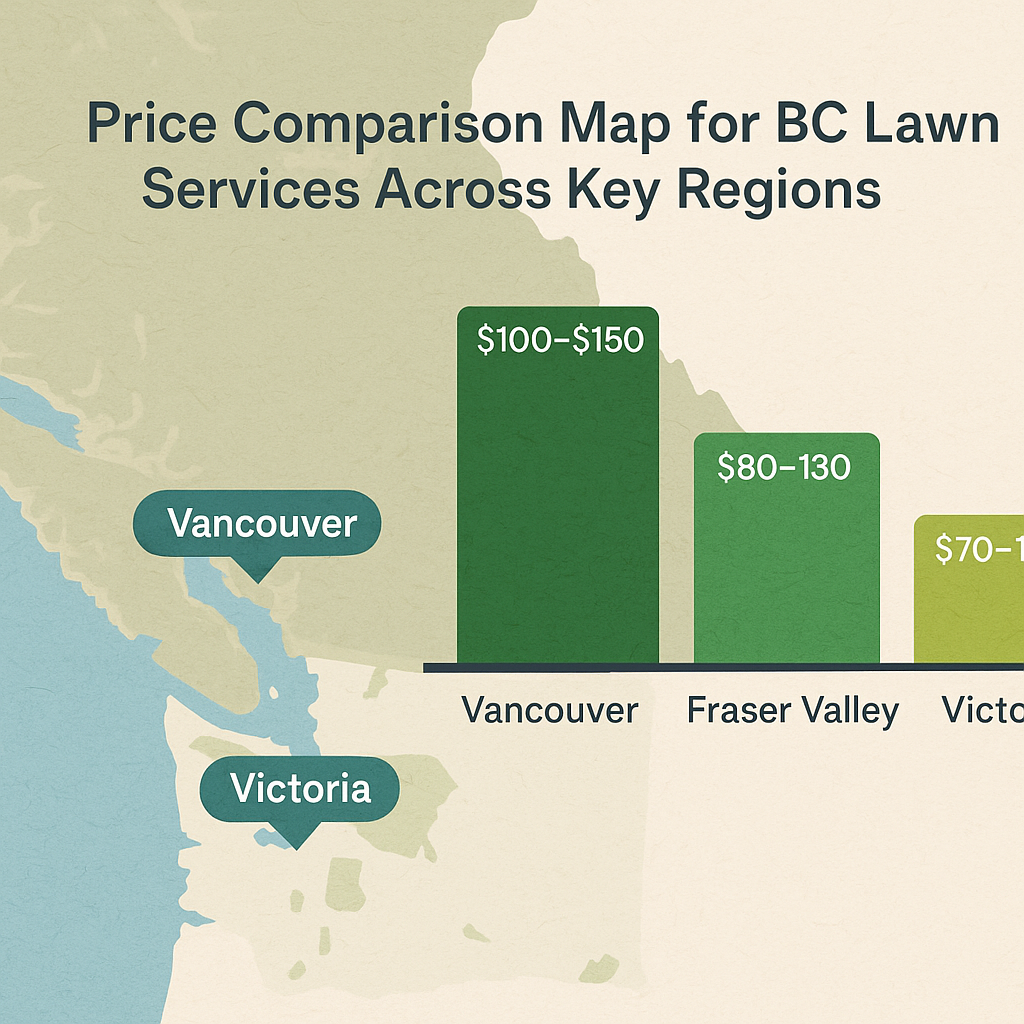
Price comparison map for BC lawn services across key regions.
📊 BC Pricing Models
1. Per Hour ($35-$85/hour in Lower Mainland, $25-$65 elsewhere) ⏰
Best for: Jobs with uncertain scope in areas like West Vancouver’s steep properties
Metro Vancouver: $45-$85/hour (Vancouver, Burnaby, Richmond, North Shore)
Municipal contracts: Cities, towns, school districts (requires proper certification)
📍 BC Service Area Definition
Metro Vancouver: Start with a 15-25km radius due to traffic/bridge considerations 🌉 Fraser Valley: 20-30km radius due to more spread-out properties 🚗 Vancouver Island: Focus on specific municipalities (Victoria, Saanich, etc.) 🏝️ Interior BC: May need larger radius due to population density 🏔️
Consider BC-Specific Factors:
Bridge tolls/traffic: Factor travel time into pricing for Port Mann, Lions Gate crossings
Ferry schedules: If serving Gulf Islands or Vancouver Island
Mountain/weather conditions: Interior and northern BC seasonal accessibility
Fuel costs: BC has some of Canada’s highest gas prices 💸
🏘️ Prime BC Neighborhoods to Target
High-Value Areas (Premium Pricing): 💎
West Vancouver, British Properties
Vancouver: Shaughnessy, Point Grey, Kerrisdale
Richmond: Granville area, Terra Nova
Burnaby: Capitol Hill, Buckingham Heights
Victoria: Oak Bay, Uplands, Cadboro Bay
Growing Middle-Class Areas (Standard Pricing): 🏡
Surrey: South Surrey, Fleetwood, Fraser Heights
Langley: Willoughby, Brookswood
Coquitlam: Burke Mountain, Westwood Plateau
Richmond: Ironwood, Seafair
Victoria: Saanich, Esquimalt
Volume/Efficiency Areas (Competitive Pricing): 📊
Surrey: Newton, Guildford, Whalley
Burnaby: Brentwood, Lougheed
Richmond: Hamilton, McLennan
Langley: Walnut Grove, Murrayville
Delta: Ladner, Tsawwassen
🛠️ Services to Offer
While mowing is your core service, additional offerings can significantly increase revenue and customer loyalty:
🌱 Basic Services
Lawn Mowing: Your primary service 🚜
Edging: Clean lines around sidewalks, driveways, and beds ➖
Trimming: Around trees, fences, and obstacles ✂️
Blowing/Cleanup: Removing clippings from hard surfaces 🌪️
🌺 Seasonal Services
Spring: 🌸
Spring cleanup and debris removal 🧹
Lawn dethatching 🔄
First fertilizer application 🌱
Flower bed preparation 🌷
Summer: ☀️
Regular mowing and maintenance 🚜
Weed control 🌿
Irrigation system checks 💧
Drought stress monitoring 🌡️
Fall: 🍂
Leaf removal and cleanup 🍃
Final fertilizer applications 🌱
Aeration services 🕳️
Winter preparation ❄️
Winter: ❄️
Snow removal (where applicable) ⛄
Equipment maintenance 🔧
Planning and marketing for next season 📋
➕ Add-On Services (Higher Profit Margins)
Fertilization: Requires pesticide license but offers recurring revenue 🌱
Weed Control: High-value service for quality-conscious customers 🌿
Aeration: Seasonal service with good profit margins 🕳️
Implement clear payment terms and follow-up procedures 📞
Consider requiring deposits for new customers 💵
🌧️ Weather Dependencies
Challenge: Rain and extreme weather disrupt schedules. Solutions: 💡
Build flexibility into scheduling 📅
Communicate proactively with customers about delays 📞
Develop indoor work for slow periods (equipment maintenance, marketing) 🏠
Consider services that can be performed in light rain 🌦️
🏢 Competition from Larger Companies
Challenge: Big landscaping companies may undercut prices or outspend on marketing. Solutions: 💡
Focus on personalized service and flexibility 🤝
Build strong customer relationships ❤️
Specialize in specific services or neighborhoods 🎯
Emphasize local ownership and community involvement 🏘️
💻 Technology and Tools for Success
Modern lawn care businesses benefit from technology integration:
📱 Business Management Software
LawnPro, GreenLawn Management, or Service Autopilot for scheduling and customer management 📅
QuickBooks for accounting and financial tracking 💰
Square or PayPal for mobile payment processing 💳
📞 Communication Tools
Customer communication apps for scheduling and updates 📱
GPS tracking for route optimization 🗺️
Weather apps for planning and customer communication 🌦️
📈 Marketing Technology
Social media scheduling tools for consistent online presence 📱
Email marketing platforms for customer communication 📧
Website builders for professional online presence 🌐
🌍 Environmental Considerations
Modern consumers increasingly value environmental responsibility:
🌱 Eco-Friendly Practices
Use electric equipment when possible ⚡
Implement grasscycling (leaving clippings on lawn) 🌾
Offer organic fertilization options 🌿
Practice water-efficient lawn care techniques 💧
Properly dispose of all waste materials ♻️
📢 Sustainability Marketing
Highlight environmental benefits of electric equipment 🌍
Educate customers about sustainable lawn care practices 📚
Offer native plant and drought-resistant landscaping 🌵
Partner with environmental organizations for credibility 🤝
🎯 Conclusion: Your Path to Success
Starting a successful lawn mowing business requires careful planning 📋, the right equipment ⚙️, and dedication to customer service 🤝. The lawn care industry offers excellent opportunities for entrepreneurs willing to work hard and smart 💪.
🔑 Key Success Factors:
Choose the right equipment for your market and service area 🎯
Price your services to ensure profitability while remaining competitive 💰
Focus on customer service to build loyalty and referrals ⭐
Plan for seasonal fluctuations with diversified services and financial management 📊
Scale thoughtfully by reinvesting profits in equipment and possibly employees 📈
Remember: Success in the lawn care business comes from consistency ✅, quality work 🏆, and building strong customer relationships 🤝. Start small, learn from experience, and grow at a sustainable pace 📈.
The lawn care industry continues to grow as homeowners increasingly value their time ⏰ and seek professional services 💼. With proper preparation and execution, your lawn mowing business can provide both financial success 💰 and the satisfaction of working outdoors while serving your community 🌟.
Whether you’re starting as a weekend side hustle or launching a full-time venture 🚀, the foundation you build today will determine your long-term success. Take time to plan thoroughly 📋, invest in quality equipment 🛠️, and always prioritize customer satisfaction 😊—your future business will thank you for it! 🎉
❓ Frequently Asked Questions (FAQs)
💰 How much money do I need to start a lawn mowing business?
You can start with as little as $1,300-$2,450 for a basic side business setup, or $10,000-$24,000 for a professional operation. The minimum includes a basic push mower ($300-$500), trimmer and tools ($200-$300), safety equipment ($100-$150), transportation setup ($200-$500), and business registration/insurance ($500-$1,000). Many successful businesses start small and reinvest profits into better equipment over time! 📈
📋 Do I need a license to start a lawn mowing business?
For basic mowing services, you typically only need a general business license ($50-$200 annually) and liability insurance. However, you’ll need a pesticide applicator license if you plan to apply fertilizers, herbicides, or pesticides – this is required in every province and state. Check with your local municipality for specific permit requirements, as some areas may have additional regulations for lawn care businesses. 🏛️
🌧️ What happens when it rains? Can I still make money?
Rain definitely impacts scheduling, but successful businesses plan for this! ☔ Build flexibility into your schedule, communicate proactively with customers about delays, and consider offering services that can be done in light rain or indoors (equipment maintenance, planning, marketing). Many businesses offer seasonal contracts with monthly payments to help smooth out weather-related income fluctuations. You can also develop complementary services like snow removal for winter income! ❄️
⚡ Should I choose electric or gas mowers for my business?
It depends on your target market and lawn sizes! Electric/battery mowers are better for residential areas (quieter, eco-friendly, easier maintenance), while gas mowers excel for large properties and thick grass. Many successful businesses use both: electric for suburban neighborhoods and gas for larger commercial jobs. Consider your target customers’ preferences – many affluent homeowners now prefer eco-friendly electric equipment! 🌱
📊 How much should I charge for lawn mowing services?
Pricing varies by location, but here are typical ranges: Small lawns (under 5,000 sq ft): $25-$50 💵 Medium lawns (5,000-10,000 sq ft): $50-$80 💵 Large lawns (10,000+ sq ft): $80-$150+ 💵 Use this formula: Total Price = (Labor + Equipment + Overhead + Materials) + 15-25% Profit Margin. Research local competitors and adjust based on your service quality and market positioning! 🎯
🤝 How do I find my first customers?
Start with your network! Friends, family, neighbors, and social media connections are your best initial customers. Then try door-to-door marketing in affluent neighborhoods, create a professional Facebook page and Google My Business listing, and list your services on platforms like Angi, TaskRabbit, and local Facebook groups. Offer free estimates and focus on areas with poorly maintained lawns. Word-of-mouth referrals from satisfied customers will become your best source of new business! 📢
🛡️ What insurance do I need for a lawn mowing business?
General liability insurance is essential ($33-$58 monthly) to protect against property damage and injury claims. You should also consider: Commercial auto insurance if using vehicles for business 🚗 Equipment insurance to protect against theft and damage 🔒 Workers’ compensation when hiring employees 👷♂️ Many insurance companies offer specialized lawn care business packages that bundle these coverages at a discount! 📋
📅 Is lawn mowing seasonal? How do I make money year-round?
Answer: Yes, lawn mowing is seasonal with peak demand in spring 🌸 and summer ☀️. Plan for this by: Saving 20-30% of peak season revenue for slow periods 🏦 Offering winter services like snow removal ❄️ Providing fall services like leaf cleanup and aeration 🍂 Offering annual contracts with monthly payments for steady cash flow 💳 Using slow periods for equipment maintenance, marketing, and business planning 📋
👥 When should I hire employees?
Consider hiring when you’re consistently working 50+ hours per week, customer demand exceeds your capacity, or you want to focus on business development rather than operations. Look for reliable, punctual people with strong work ethics – you can train the technical skills! 💪 Remember that employees add costs: wages ($15-$25/hour), workers’ compensation insurance, payroll taxes, and equipment expenses. Make sure your revenue can support these additional costs before expanding! 📈
🚀 What’s the biggest mistake new lawn care businesses make?
Underpricing services! Many new businesses try to compete solely on price, which leads to burnout and business failure. Instead, focus on: Quality service that justifies fair pricing 🏆 Building relationships with customers for loyalty ❤️ Proper pricing that ensures 15-25% profit margins 💰 Professional presentation with quality equipment and appearance 👔 Reliable service – always show up on time and communicate proactively 📞 Remember: customers who only care about the lowest price are often the most difficult to work with. Target customers who value quality and reliability! ⭐